Five Elements Relationships: Resonance between body, emotion, season, and the more-than-human world
The Five Elements relationships describe how humans, nature, seasons, emotions, and living systems continuously influence one another. Rooted in Traditional Chinese Medicine (TCM) and Daoist philosophy, the Five Elements (Wuxing 五行) are understood as dynamic, relational forces. They do not exist in isolation, nor do they “cause” one another in a linear way. Instead, they co-arise and respond to one another, shaping both the outer world and our inner experience.
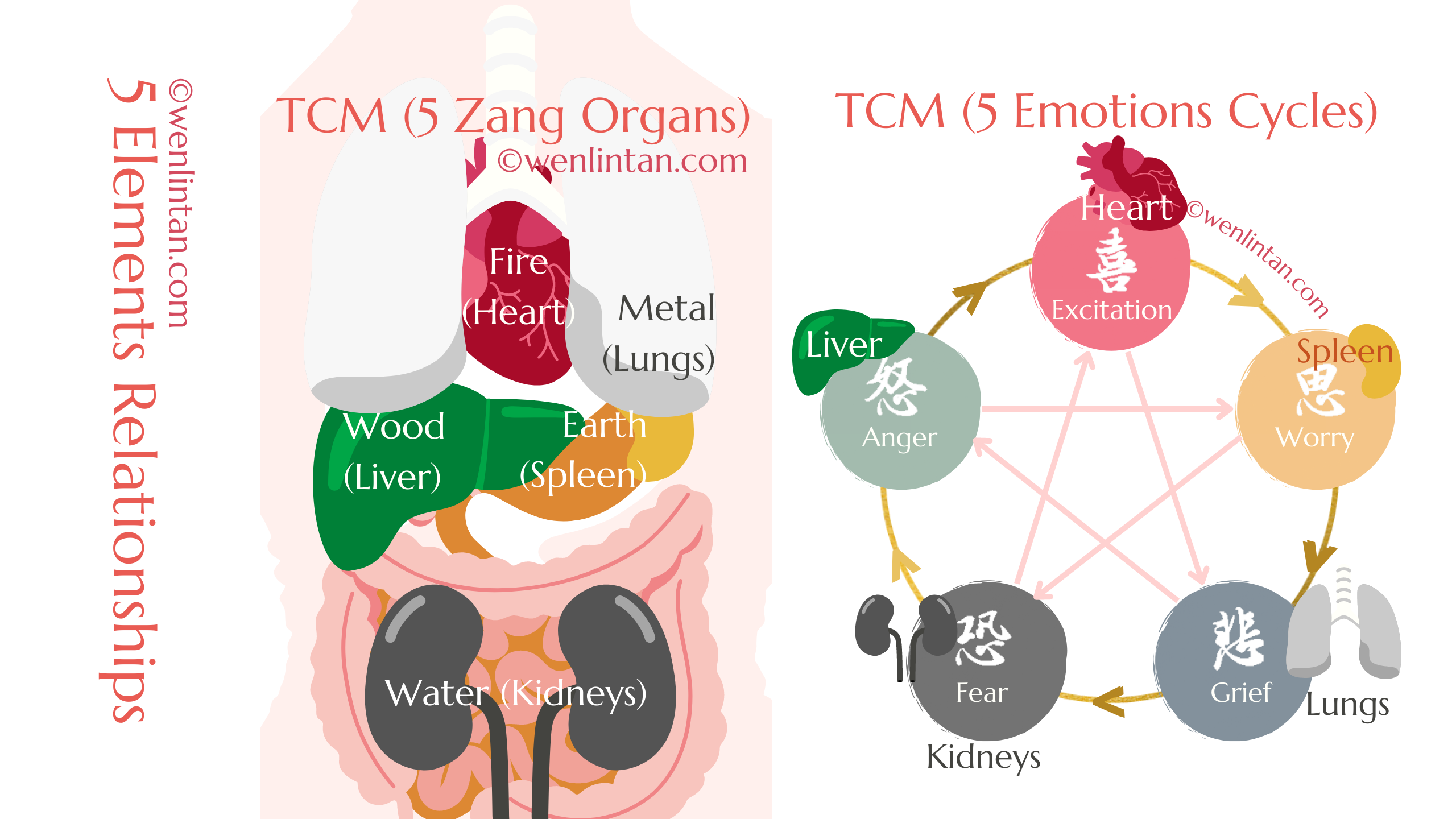
This is why the Five Elements are best understood as a living system of relationships (rather than checklist of correspondences). Depicted below are the Five Elements Relationships showing how the Wuxing 五行 (Five Moving Forces / Dynamics / Phases / Energetic qualities) which are Wood 木, Fire 火, Earth 土, Metal 金 and Water 水 are related to phenomena and transitions in the external world and internal world.
Five Elements Relationships as Resonance, Not Correlation
Classical Chinese texts such as the Huangdi Neijing 黄帝内经 and Bai Hu Tong 白虎通德伦describe the Five Elements as operating through resonant interaction rather than symbolic association.
Ancient texts such as the Huang Di Nei Jing 黄帝内经 and Bai Hu Tong 白虎通德伦 have established relationships of these forces with smells, sounds, colours, directions, senses, seasons, emotions and interestingly, even virtues.
In the book, Humming with Elephants: A Translation and Discussion of the “Great Treatise on the Resonant Manifestations of Yīn and Yáng”, physician and translator Sabine Wilms explains, these relationships are not merely metaphorical. The heart does not simply “represent” fire, nor do the kidneys merely “symbolise” water. They are physically and energetically affected by seasonal cycles, climatic shifts, diet, emotion, sound, and rhythm.
‘…I have learned to emphasize the key difference between mere “correlation” or “association” with actual “resonance”. In chinese medicine the heart is not just associated with or related to fire and summer, and the kidney to water and winter, but lierally and physically affected by it. As such the internal organs in the human body and its associated emotions, physical constitutents, sensory organs etc. change in direct and observable response to seasonable cycles, diet, astronomical events, and other micro- or macrocosmic fluctuations or happenings. All of these ceaseless changes are summarized in the TCM classic, Huangdi Neijing as the Dao of Heaven and Earth.’
In this view, the body is not separate from nature.
It is nature, condensed and responsive.
What happens in the wider world — changes in light, temperature, sound, moisture, movement — is mirrored and felt within us.
If you are new to the Five Elements read this introduction to the Five Elements first.
Humans as microcosm of the macrocosm
One of the most radical implications of the Five Elements is this: humans are not outside the system they seek to understand. We are a microcosm of the same forces shaping rivers, forests, weather patterns, and seasons. The emotions we experience, the cycles we move through, and the ways our bodies respond are expressions of the same elemental dynamics at work everywhere. This understanding gently disrupts a human-centric worldview.
Rather than positioning humans as managers of nature, the Five Elements invite us to listen, attune, and participate in patterns that already exist.
Five Elements as lived experience
Each Element expresses itself simultaneously across multiple dimensions:
in the body (organs, tissues, sensations)
in emotion and mood
in seasons and phases of time
in sound, colour, scent, and movement
in psychological and creative tendencies
These expressions are not fixed identities.
They shift according to context, balance, and relationship.
Understanding the Five Elements relationships helps us notice:
where energy is flowing with ease
where it becomes constrained or excessive
how imbalance often reflects a wider relational or environmental context
Rather than asking “What’s wrong with me?”, the Five Elements encourage a different question:
What is out of rhythm — and what is asking to be restored?
Why Five Elements Relationships Matter In Contemporary Life
In a world shaped by speed, fragmentation, and constant stimulation, the Five Elements offer a way to return to pattern, rhythm, and relationship.
They remind us that emotional states are not personal failures, but signals.
That exhaustion, anxiety, or stagnation are not problems to fix, but messages to listen to.
That healing often comes not from force, but from re-establishing resonance — within ourselves and with the world around us.
This perspective underpins my work in embodied coaching, embodied listening, and the Creative Cycle, where change is approached as a relational process rather than a linear task.
Restoring resonance in lived experience
Understanding the Five Elements relationships is not an intellectual exercise.
It is an invitation to notice where rhythm has been lost — and where it can be re-established through presence, listening, and care.
In my work, these principles are explored not as theory, but as embodied practice.
Through embodied listening, I work with individuals, groups, and ecological contexts to cultivate deeper attunement — listening with the body, emotions, and environment rather than overriding them.
Through embodied coaching, I support women in creative emergence, transition, and change to restore trust in their own timing, intuition, and inner rhythms, using the Five Elements and Creative Cycle as living frameworks rather than fixed maps.
If you’re curious to explore how these ideas might support your own process — whether personal, creative, or relational — you’re welcome to begin here:
→ Explore Embodied Coaching
→ Learn more about Embodied Listening