The Five Elements (Wuxing 五行): A relational framework for living as part of a more-than-human world
The Five Elements (Wuxing 五行) are a foundational framework in Daoist philosophy and Traditional Chinese Medicine (TCM) that describe how life moves, changes, and relates. Rather than separating humans from nature, they offer a way of understanding ourselves as expressions of the same living patterns that shape seasons, ecosystems, and the wider world.
In this view, humans are not outside observers of nature. We are a microcosm of the macrocosm — shaped by the same rhythms, forces, and transformations that move through the land, the climate, and the cosmos. The Five Elements provide a language for sensing and living this interconnection, not as an abstract idea, but as an embodied reality.

What are the Five Elements?
In Traditional Chinese Medicine, the Five Elements are not static substances, but dynamic phases or moving forces. The term Wuxing 五行 is often translated as “Five Elements,” yet Xing 行 also means movement, unfolding, path, or way. This points to an understanding of life as process rather than object.
The Five Elements — Wood 木, Fire 火, Earth 土, Metal 金, and Water 水 — describe cyclical patterns of growth, transformation, maturation, release, and return. They are not hierarchical, nor do they follow a single linear beginning or end. Instead, they arise together through the dynamic interplay of Yin and Yang, continuously transforming into one another.
This cyclical understanding stands in contrast to linear models of progress or productivity. Within the Five Elements framework, change is rhythmic, contextual, and relational.
Humans as part of the same pattern
One of the most radical implications of the Five Elements is the way they reposition the human being. Rather than placing humans at the centre, the framework situates us within a larger field of relationships.
Classical Chinese medicine describes humans as a bridge between Heaven, Earth, and Humanity (天地人). Our bodies, emotions, perceptions, and cycles resonate directly with seasonal changes, climatic conditions, and environmental shifts. This is not metaphorical. It is experiential and observable.
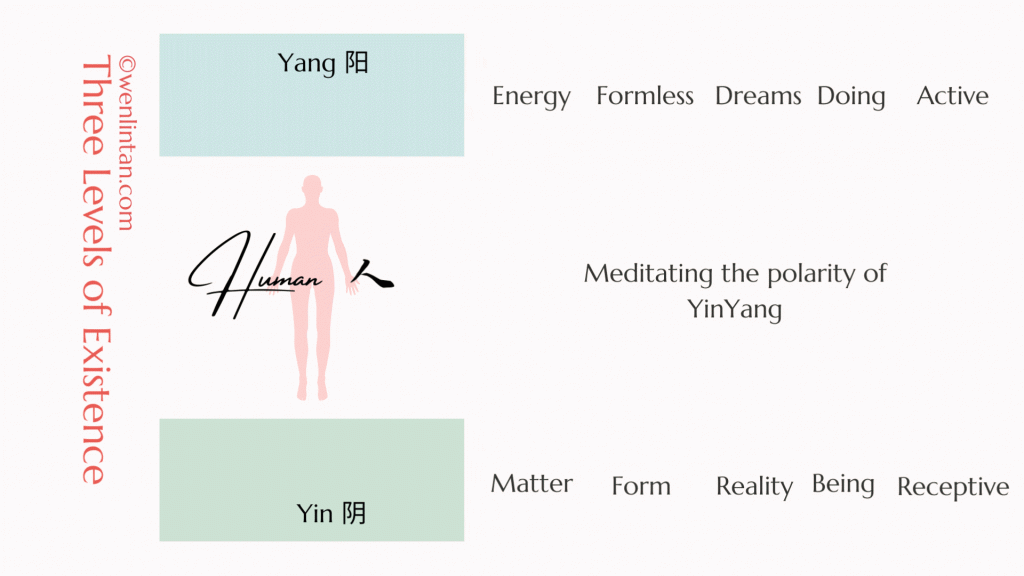
Ancient texts such as the Huangdi Neijing describe how the organs, emotions, senses, and rhythms of the human body respond directly to changes in season, time of day, diet, climate, and place. The Five Elements are therefore not symbolic associations, but resonant relationships — living correspondences that affect us physically, emotionally, and energetically.
To work with the Five Elements is to remember that we belong to a living system far larger than ourselves.
Yin–Yang and the Five Elements framework
The Five Elements emerge from the dynamic relationship between Yin and Yang — complementary forces that arise together and depend on one another. Yin and Yang are not opposites in conflict, but mutually generative qualities that allow life to move. As Yin and Yang interact, they give rise to the Five Elements simultaneously. No single element precedes the others. Each contains the seed of the next. Each is necessary. The cycle has no true beginning or end — only continuous transformation.
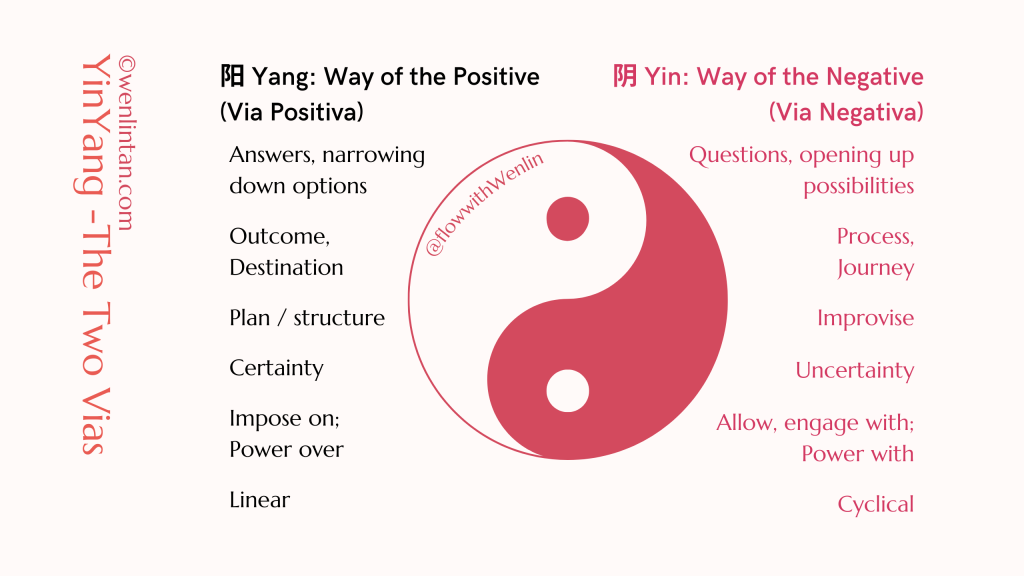
This understanding challenges linear notions of cause and effect. It invites us to see imbalance not as failure, but as information — a signal that something in the cycle is asking for attention, rest, or reorientation.
Living cyclically rather than linearly
Modern life often asks us to move in straight lines: set goals, push forward, optimise outcomes. This Five Elements offer a different orientation — one that values timing, rest, return, and renewal as much as action and growth.
Within this framework, creativity, health, and meaningful change arise not from constant effort, but from alignment with cycles. There are times for initiation and expansion, and times for consolidation, letting go, and inward listening. Each phase carries its own intelligence.
Living cyclically does not mean withdrawing from the world. It means engaging with life in a way that is sustainable, responsive, and rooted in reality rather than force.
The Five Elements: A way of embodied listening
At its heart, the Five Elements framework is a listening practice. To work with the Five Elements is to listen inwardly — to the body, emotions, energy, and intuition — while also listening outwardly to environment, season, relationship, and context. Rather than imposing control, this approach cultivates attunement.
This way of embodied listening reframes health, creativity, and decision-making as relational processes. Instead of asking, “What should I do?” the question becomes, “What phase am I in, and what is being asked of me now?”
In this sense, the Five Elements support a shift away from human-centric dominance toward a more-than-human awareness, where care, restraint, and reciprocity guide action. In a time shaped by speed, extraction, and disconnection, they offer a language for restoring relationship — with ourselves, with others, and with the living world. The Five Elements remind us that:
we are cyclical beings in a cyclical world
change unfolds through rhythm, not force
health and creativity depend on listening as much as doing
Working with the Five Elements does not provide quick fixes. It offers something more enduring: a way of living that honours complexity, interdependence, and life as it actually unfolds.
This framework informs my work across embodied coaching, listening-based practices, movement, and creative inquiry. They provide a shared framework for understanding transitions, emotional patterns, creative emergence, and periods of rest or return — without pathologising or reducing experience. If you’re curious to explore how this framework supports personal or creative transitions, you can learn more about my embodied coaching work here, or explore how the Five Elements relate to the Creative Cycle and cyclical living.
Emotions as movements, not problems
Each Element corresponds to an emotional quality, known as the Wu Qing 五情:
Wood — Anger / assertion
Fire — Joy / anxiety
Earth — Rumination / care
Metal — Grief / discernment
Water — Fear / trust
Within this framework, emotions are not something to suppress or override. They are informational movements — signals that something within us, or around us, is shifting.
Learning to work with the Five Elements supports a different relationship to emotion: one based on listening, regulation, and responsiveness, rather than control.
Read about how I helped myself and my clients balance their emotions: Healing Anger And Grief Through The Five Elements and try this free 5 Element Qigong Healing & Protection Meditation to help you dissolve difficult negative emotions and uncover your inner power.

Want to harness the energies of the Five Elements?
Try this 5 Element Qigong Yoga practice below and join my weekly Qigong classes / workshops
Try this free 5 Element Qigong Healing & Protection Meditation to help you dissolve difficult negative emotions and uncover your inner power
listen to this Podcast interview on the Five Elements of TCM & Ayurveda with Micaela of My Vinyasa Practice